Butterfly Senses & Anatomy
A butterfly's body is built entirely around flight and feeding, with senses tuned to find flowers, mates, and host plants — often in ways that have nothing to do with eyes or nose as we'd recognize them.
Tasting With Their Feet
Butterflies have chemoreceptors on their feet — essentially taste buds — that let them identify a plant the instant they land. For females, this is critical: she uses it to confirm a plant is the right host species before laying eggs there, since laying on the wrong plant means her caterpillars will starve.
The Proboscis
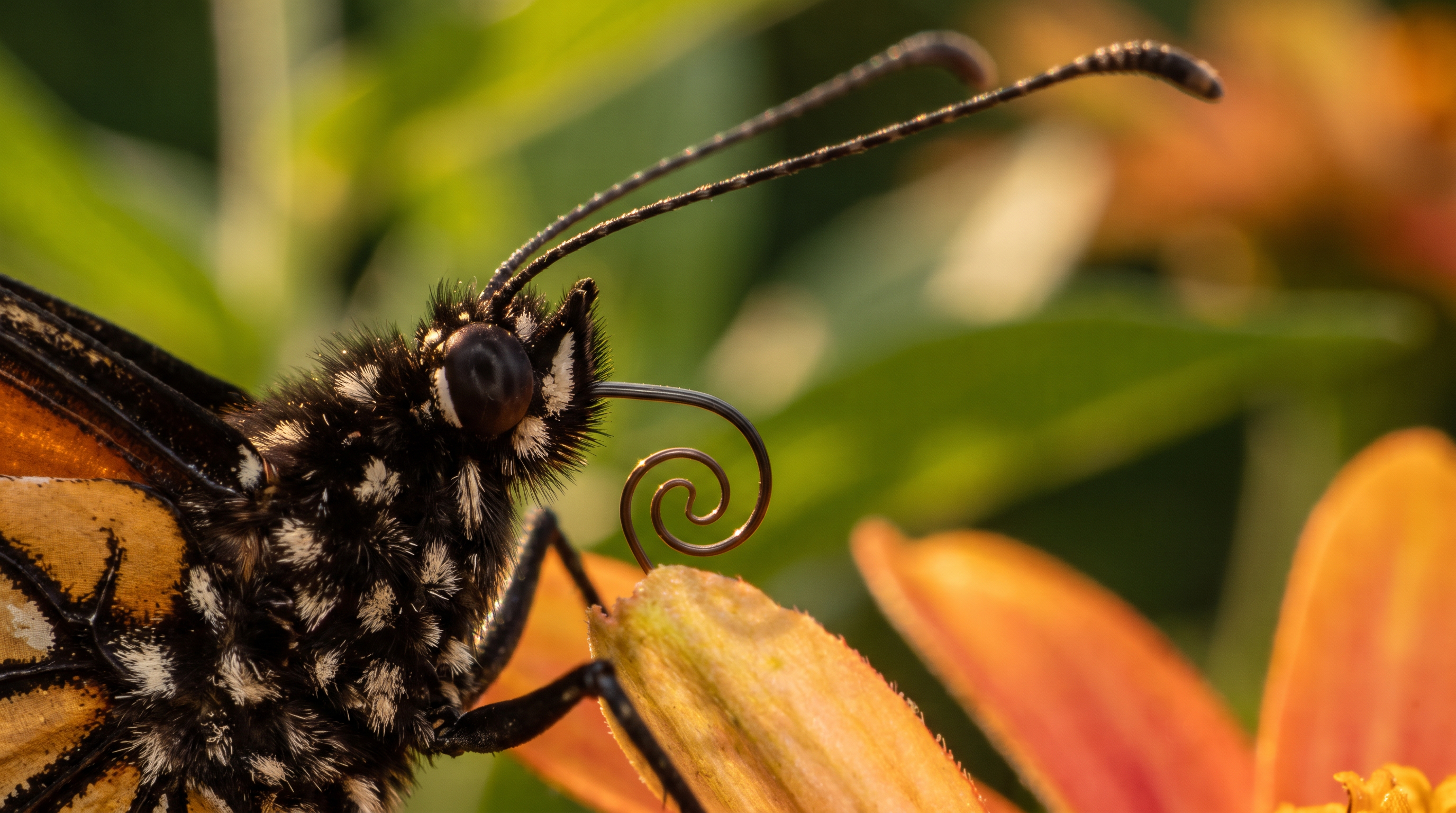
Adult butterflies drink through a proboscis, a long, flexible, straw-like tube that stays coiled beneath the head when not in use. It unfurls to reach nectar deep inside a flower, and some species — like certain hawk moths and butterflies that feed on long tubular blooms — have proboscises several inches long, far longer than their own bodies.
Antennae and Compound Eyes
Butterfly antennae are club-shaped, thickening toward the tip, and are used to detect scent, wind, and even help with balance in flight. Their large compound eyes are made of thousands of individual lenses, giving them a wide field of view and strong sensitivity to movement and color — though not sharp detail the way a human eye sees it.
Wings and Scales
Cold-Blooded Fliers
Butterflies are ectothermic — they can't generate their own body heat — so they rely on basking in direct sun with wings spread to warm their flight muscles before takeoff. On cool or cloudy days, most species simply won't fly at all, which is why butterfly activity tracks the sun so closely.